
Contents:
Key Odyssey Network Indicators

Shipper Actions
In today’s competitive environment, becoming a preferred shipper to carriers can help improve attaining sufficient capacity. Things that shippers offer that help reach this status can include:
Accuracy:
Forecast for the end of month/end of quarter – plan for surges in your needs to ensure coverage
Develop order lead time – at least 5 days in advance. ask carriers for “best case” options
Specificity:
Request delivery windows from customers…often 8 a.m. deliveries are requested when product really is not need until much later. A window of 8-10 a.m. may have a better chance of coverage.
Spread delivery times across the day
Assess what your customers really need. Make sure that customer delivery requirements are up to date and accurate. Do not require equipment/assessorials that are not needed
Flexibility:
- Offer flexible load times
- Explore/ be open to mode options including intermodal
Driver-friendliness:
- Load/unload within the normal 2 hours-time is money to drivers
- Provide creature comforts (clean restrooms, rest areas, free Wi-Fi, a cup of coffee, etc.)
Consistency:
- Offer consistent volume that carriers can plan against
- Reduce order changes – a new date may put coverage at risk
Efficiency:
- Maximize payload on trucks
- Utilize trailer drop yards at high volume origins when possible
- Prioritize loading/unloading trucks quickly at facilities
Promptness:
- Pay carriers within their contracted freight terms- cash flow is vital to carriers
Economic Update
GDP Change

Gross Domestic Product | U.S. Bureau of Economic Analysis (BEA)
Released January 22, 2026
| Q3 2025 (Updated) | +4.4% |
| Q2 2025 | +3.8% |
- Real gross domestic product (GDP) increased at an annual rate of 4.4 percent in the third quarter of 2025 (July, August, and September), according to the updated estimate released by the U.S. Bureau of Economic Analysis.
- In the second quarter, real GDP increased 3.8 percent.
- The increase in real GDP in the third quarter reflected increases in consumer spending, exports, government spending, and investment. Imports, which are a subtraction in the calculation of GDP, decreased.


Unemployment

https://www.bls.gov/charts/employment-situation/civilian-unemployment-rate.htm
Employment Situation Summary
- Total nonfarm payroll employment rose by 130,000 in January, and the unemployment rate changed little at 4.3 percent, the U.S. Bureau of Labor Statistics reported on February 11, 2026.
- Job gains occurred in health care, social assistance, and construction, while federal government and financial activities lost jobs.
- This news release presents statistics from two monthly surveys:
- The household survey measures labor force status, including unemployment, by demographic characteristics.
- The establishment survey measures non-farm employment, hours, and earnings by industry.
Household Survey Data
- Both the unemployment rate, at 4.3 percent, and the number of unemployed people, at 7.4 million, changed little in January.
- The number of long-term unemployed (those jobless for 27 weeks or more) changed little in January at 1.8 million but is up by 386,000 from a year earlier. The long-term unemployed accounted for 25.0 percent of all unemployed people in January.
- Both the labor force participation rate, at 62.5 percent, and the employment-population ratio, at 59.8 percent, changed little in January. These measures have shown little change over the year.
- The number of people employed part time for economic reasons decreased by 453,000 to 4.9 million in January but is up by 410,000 over the year. These individuals would have preferred full-time employment but were working part-time because their hours had been reduced or they were unable to find full-time jobs.
- In January, the number of people who are not in the labor force who currently want a job decreased by 399,000 to 5.8 million. These individuals were not counted as unemployed because they were not actively looking for work during the 4 weeks preceding the survey or were unavailable to take a job.
Establishment Survey Data
- Total non-farm payroll employment rose by 130,000 in January. Job gains occurred in health care, social assistance, and construction, while federal government and financial activities lost jobs. Payroll employment changed little in 2025 (+15,000 per month on average).
- Employment in social assistance increased by 42,000 in January, primarily in individual and family services (+38,000).
- In January, federal government employment continued to decline (-34,000) as some federal employees who accepted a deferred resignation offer in 2025 came off federal payrolls. Since reaching a peak in October 2024, federal government employment is down by 327,000, or 10.9 percent.
- Financial activities employment declined by 22,000 in January and is down by 49,000 since reaching a recent peak in May 2025. Within the industry, insurance carriers and related activities lost 11,000 jobs over the month.
- Employment showed little change over the month in other major industries, including mining, quarrying, and oil and gas extraction; manufacturing; wholesale trade; retail trade; transportation and warehousing; information; professional and business services; leisure and hospitality; and other services.
- In January, average hourly earnings for all employees on private non-farm payrolls rose by 15 cents, or 0.4 percent, to $37.17. Over the past 12 months, average hourly earnings have increased by 3.7 percent. In January, average hourly earnings of private-sector production and nonsupervisory employees rose by 12 cents, or 0.4 percent, to $31.95.
- The average workweek for all employees on private non-farm payrolls edged up by 0.1 hour to 34.3 hours in January. In manufacturing, the average workweek edged up by 0.1 hour to 40.1 hours, and overtime was unchanged at 2.9 hours. The average work week for production and nonsupervisory employees on private non-farm payrolls increased by 0.1 hour to 33.8 hours.
U.S. Truck Transportation Employment

Updated February 11, 2026
All Employees, Truck Transportation (CEU4348400001) | FRED | St. Louis Fed
Manufactured Goods – New Orders

https://www.census.gov/manufacturing/m3/current/index.html
Released January 29, 2026
Monthly Full Report on Manufacturers’ Shipments, Inventories, & Orders
(Released January 7, 2026)
- New orders for manufactured goods in November, up three of the last four months, increased $16.2 billion or 2.7 percent to $621.6 billion, the U.S. Census Bureau reported today. This followed a 1.2 percent October decrease.
- Shipments, down three of the last four months, decreased $0.8 billion or 0.1 percent to $606.3 billion. This followed a 0.1 percent October increase.
- Unfilled orders, up sixteen of the last seventeen months, increased $20.2 billion or 1.4 percent to $1,513.5 billion. This followed a 0.2 percent October increase.
- The unfilled orders-to-shipments ratio was 7.04, up from 6.93 in October. Inventories, up two consecutive months, increased $1.4 billion or 0.1 percent to $948.4 billion. This followed a virtually unchanged October increase.
Transportation Update
Fuel
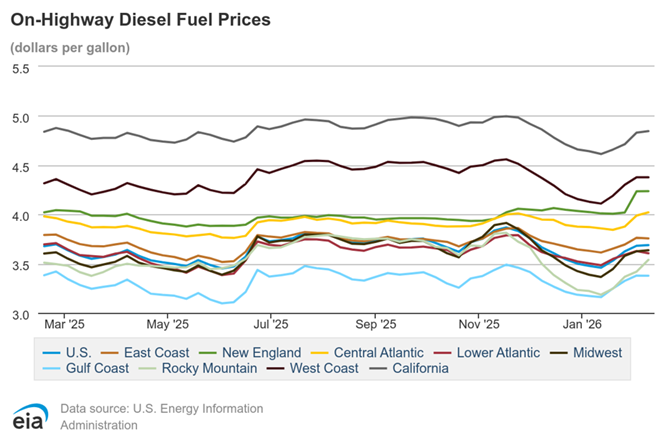
https://www.eia.gov/petroleum/gasdiesel/?os=frefapp
The national average price of diesel for the week of January 26 stood at $3.62 per gallon, an increase of 12 cents from four weeks prior at the end of December and up $0.02 from a year ago.
Transportation Capacity

- The Transportation Capacity Index rebounded 10.2 points to 47.1 percent in January 2026.
- Despite this large increase, the Transportation Capacity index remains below the critical threshold and indicates slight contraction. While the Upstream Transportation Capacity index is at 45.9, the Downstream index is at 50.0 but the difference is not statistically significant.
- The future Transportation Capacity index increased 1.8 points, and it is now at 42.3, still indicating contraction for the next 12 months. While the future Upstream index is at 42.4, the Downstream Transportation Capacity index is at 42.2, and the difference is not statistically significant. As such, the expectations of future contractions are prevalent across the supply chains, both Upstream and Downstream.
Transportation Prices

https://www.the-lmi.com/january-2026-logistics-managers-index.html
- The Transportation Prices Index increased another 4.7 points from the previous reading and recorded 71.4 in January 2026. With this increase, the index is 1 point lower than the level indicated one year ago.
- While the Upstream Transportation Prices Index is at 71.8, the Downstream index is at 70.6 and the difference is not statistically significant. As such, it can be concluded that the inflationary pressure on Transportation prices is being felt strongly across the supply chains, both Upstream and Downstream.
- The future index for Transportation prices also increased from last month, indicating 79.5 level for the next year. The Upstream future Transportation prices index is at 81.0 while the Downstream Transportation prices index is at 75.8, and the difference is not statistically significant. Therefore, inflationary expectations in Transportation prices are prevalent across the supply chains, both Upstream and Downstream.
Cass Freight & Truckload Index
Truckload Rates on the Rise

Source: Cass Information Systems, Inc.
https://www.cassinfo.com/freight-audit-payment/cass-transportation-indexes/january-2026

https://www.cassinfo.com/freight-audit-payment/cass-transportation-indexes/january-2026
The Cass Truckload Linehaul Index is a measure of market fluctuations in per-mile truckload linehaul rates, independent of additional cost components such as fuel and accessorials.
The Cass Truckload Linehaul Index rose 1.7% month over month in January, after a 1.0% increase in December.
- Rates rose 3.2% year over year as weather challenged volumes. Warmer weather should lead to some trend reversion, but for February at least, spot rates are likely to accelerate.
- This index is mostly comprised of contract rates, and anecdotally we hear about more shippers initiating one-year bids, suggesting movement in the cycle beyond just weather effects.
- This index reflects the whole for-hire market, both spot and contract rates.
This index fell 10% in 2023, another 3.4% in 2024, and turned up to a 1.8% increase in 2025.
Truck Tonnage Index
U.S. Bureau of Transportation Statistics
Truck Tonnage Index (TRUCKD11) | FRED | St. Louis Fed
From the St Louis Federal Reserve on February 2, 2026.

ATA Truck Tonnage Index
The Index Rose 0.4% in December
https://trucking.org/news-insights/ata-truck-tonnage-index-rose-04-december
From the American Trucking Associations (ATA) on January 20, 2026.
- Trucking activity in the United States increased slightly in December, but volumes remained at low levels after significant declines in September and October. Specifically, truck freight tonnage increased 0.4% after rising 0.2% in November, according to the American Trucking Association’s advanced seasonally adjusted For-Hire Truck Tonnage Index.
- “Despite two consecutive gains, tonnage remains at low levels as the freight metric contracted a total of 2.7% in September and October,” said ATA Chief Economist Bob Costello. “Soft manufacturing and construction activity are continuing to suppress freight levels, as they did for much of last year. For 2025 in total, tonnage rose just 0.1% over the 2024 average, although it was the first annual gain since 2022.”
- In December, the ATA advanced seasonally adjusted For-Hire Truck Tonnage Index equaled 112.9, up from 112.4 in November. The index, which is based on 2015 as 100, increased 0.9% from the same month in 2024 after decreasing the two previous months on a year-over-year basis. For the fourth quarter, the index average fell 1.8% from the third quarter, the largest sequential quarterly decline since the second quarter of 2023, and was down 0.3% from the final three months in 2024.
- The not seasonally adjusted index, which calculates raw changes in tonnage hauled, equaled 111.9 in December, 4.3% above November’s reading of 107.3.
- Trucking serves as a barometer of the U.S. economy, representing 72.7% of tonnage carried by all modes of domestic freight transportation, including manufactured and retail goods. Trucks hauled 11.27 billion tons of freight in 2024.* Motor carriers collected $906 billion, or 76.9% of total revenue earned by all transport modes.


National Spot Rates

Source: DAT Analytics | https://www.dat.com/trendlines
The chart above depicts national average rates (including fuel surcharges) in the past 13 months, derived from DAT RateView.