Cost pressure is pushing sustainability off most shippers' priority lists. A set of reporting requirements arriving in 2027 makes that a short-sighted response — and Odyssey's approach offers a way through.
By Victor Thomas, VP HSSE, Odyssey Logistics
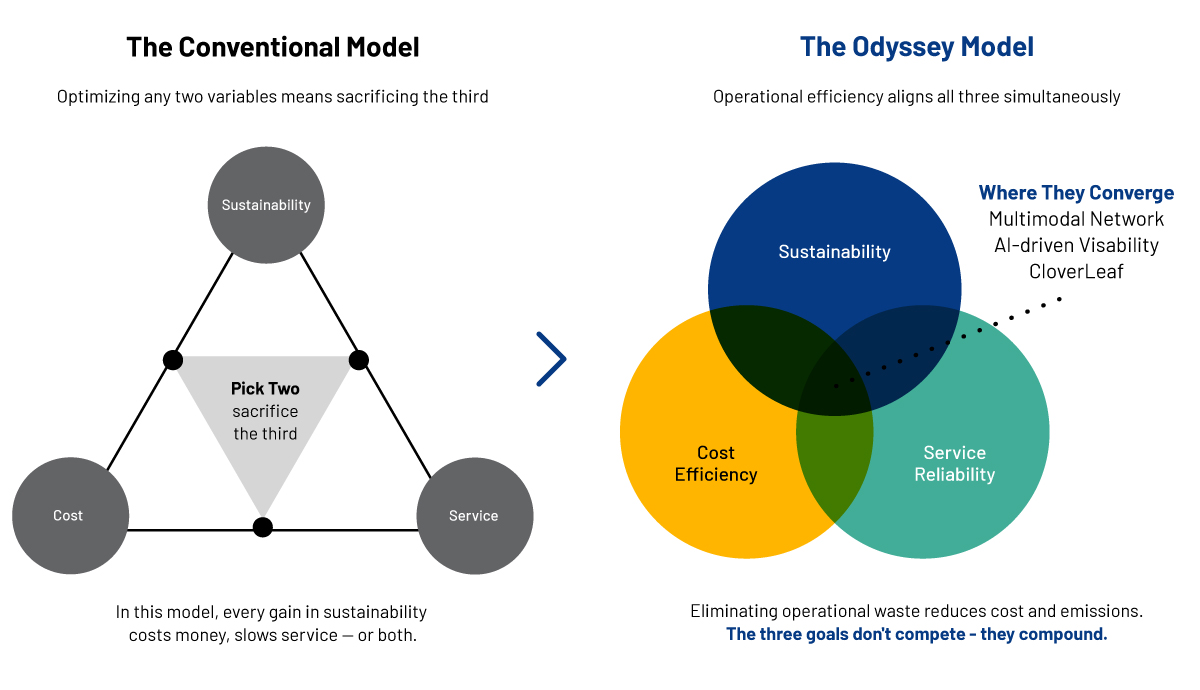
Cost, service, and sustainability are sometimes described as a freight “trilemma”: optimizing any two means conceding the third. In 2026, cost is the top priority. Freight capacity tightened through Q1, with the Flatbed Outbound Tender Reject Index spiking to 48.74% according to FreightWaves, and tariff volatility put further pressure on the supply chain. Against this backdrop, sustainability has become the variable that gives. Service didn’t, because customers notice missed deliveries in ways they don’t notice a deferred carbon target.
Odyssey Logistics is preparing its customers by posing a fundamental question: what if the premise of the trilemma is wrong? What if cost, service and sustainability don’t have to compete — and can instead compound and complement one another? The data infrastructure required to report Scope 3 accurately is the same infrastructure required to find and eliminate freight cost inefficiencies. For supply chain teams navigating both today’s cost pressure and next year’s Scope 3 deadlines, this approach makes 2026 cost-control and 2027 compliance the same project.
Why conventional solutions make the trilemma worse
Green capital investment and blunt cost-cutting both deepen the tension rather than resolve it — because they treat the three variables as separate problems.
For shippers who are prioritizing sustainability, the most common response is capital investment in green technology. This tends to worsen the trilemma, however: Class 8 electric vehicles cost roughly twice what a diesel truck costs, and biofuels are uneconomical on long-haul lanes. Charging infrastructure, meanwhile, remains years from the scale required for most freight networks.
These are risky investments, and in 2026 they move cost in the wrong direction without delivering proportionate emissions benefit while threatening service. Odyssey’s model offer sustainability, however, starts from a different premise entirely.
Operational efficiency is where cost, carbon and service already meet
Operational waste drives up cost, drives up emissions and drives down service. Remove it and all three move.
Every unnecessary mile driven, every suboptimal mode selection, every redundant freight handoff generates both excess cost and excess emissions — and creates the transit variability that erodes service reliability. Address the waste and all three move in the right direction simultaneously. This is Odyssey’s model of sustainability, and it requires no green capital investment from the shipper.
Modal substitution on the right lanes. Odyssey’s modal-shift analysis identifies lanes where truck-to-rail conversion reduces cost-per-unit and CO₂ simultaneously — typically lanes over 500 miles where Odyssey’s stack train network provides schedule reliability that spot truck cannot consistently match. The shipper gets a lower-cost, lower-emission move from the same freight decision, without changing their service commitments.
AI-assisted network optimization. A manufacturer running 700 lane combinations across multiple distribution points cannot optimize that network from inside their own data. Odyssey’s platform evaluates lane mix, modal allocation and cost-per-move across the full freight network — surfacing substitution opportunities that reduce both loaded miles and cost simultaneously.
Distribution footprint rationalization. Optimizing individual shipments matters less than reducing the number of moves required. Odyssey coordinates across its full multimodal network with the visibility to find systemic waste that single-mode providers cannot see. Warehouse network rationalization — reducing facilities, repositioning inventory closer to demand — cuts cost, cuts transportation miles, and puts inventory where it can better satisfy delivery commitments.
CloverLeafTM. Odyssey’s flagship sustainability program connects emissions reduction directly to operational decisions — routing, asset utilization, carrier selection — optimizing for cost, service reliability and environmental impact together rather than treating sustainability as a separate layer.
The precondition for all of this is data-driven visibility. Disconnected or manual systems cannot identify these opportunities. Odyssey’s mature data infrastructure allows shippers to pursue a practical path to both cost optimization and emissions reduction.
2026’s cost work is 2027’s Scope 3 prep
The data required to find cost inefficiencies in your freight network is the same data required to report Scope 3 emissions accurately. Odyssey helps you treat them as one project.
The network visibility that drives cost optimization — lane-level emissions data, modal performance tracking, carrier efficiency metrics — is exactly what Scope 3 disclosure requires. A shipper who works with Odyssey through 2026 to rationalize their freight network arrives at 2027 reporting deadlines with this infrastructure already built. There’s no separate compliance project and no scramble.
This is the compounding effect Odyssey offers: the same work that reduces cost in 2026 produces the emissions data that satisfies Scope 3 disclosure in 2027 — and the operational discipline that earns customer trust beyond either deadline.
Schedule a consultation with one of our sustainability experts today.
Frequently asked questions
How can freight cost reduction and emissions reduction happen at the same time?
Operational waste produces both excess cost and excess emissions simultaneously. Removing waste — through modal substitution, freight consolidation, network rationalization and smarter routing — reduces both. Truck-to-rail shifts on lanes over 500 miles lower cost-per-unit and cut CO₂ emissions from the same decision, with no green capital investment required from the shipper.What is Scope 3 emissions reporting and what does it require from shippers?
Scope 3 emissions are indirect emissions generated in a company’s value chain — including transportation by third-party logistics providers. California SB 253 requires large companies operating in California to disclose these emissions beginning in 2027. Compliance requires granular data on lane-level emissions, modal performance and carrier efficiency — not necessarily emissions reductions, but accurate measurement and reporting. Shippers who build network visibility for cost optimization purposes will have that data infrastructure in place when reporting deadlines arrive.
Does sustainability investment require significant capital outlay for shippers?
The highest-leverage sustainability gains in freight logistics — modal substitution, network rationalization, freight consolidation — require no green capital investment from the shipper. They require data visibility and a logistics partner with the multimodal infrastructure to act on network optimization opportunities. Capital-intensive solutions like fleet electrification deliver marginal emissions benefit relative to operational efficiency gains in most freight networks today.
How does safety connect to sustainability in freight logistics?
In regulated freight categories, the operational disciplines that protect service reliability — carrier vetting, route discipline, real-time visibility — also reduce environmental incident risk. A single fuel spill incident can cost $200,000 or more in remediation. Shippers who invest in operational rigor for safety reasons receive sustainability benefits as a consequence. Odyssey’s integrated HSSE function reflects this connection directly.
How does Odyssey’s CloverLeafTM program work?
CloverLeafTM is Odyssey’s sustainability program that connects emissions reduction to operational decisions — routing, asset utilization, carrier selection — rather than treating sustainability as a separate reporting layer. It uses actionable data to identify opportunities to reduce costs and lower environmental impact simultaneously, producing sustainability outcomes as a product of network efficiency rather than green capital investment.