Odyssey’s culture of innovation shapes how its technology is built. Shippers inherit the results.
By Maneet Singh, Chief Information Officer and Chief Digital Officer, Odyssey Logistics
That is where Odyssey’s focus on integrated intelligence comes in as a feature and benefit.
The inherent challenge for shippers is not a lack of information, but rather turning that information into decisions quickly enough to keep pace with changing conditions. Odyssey is building technology around that challenge: combining AI, live operational data, and the knowledge of our people to help shippers make smarter decisions, faster and at scale.
But the point is not to make logistics less human. It is to make the people-making decisions more informed and better equipped to act, and act quickly. When you can operate from a single working picture, you gain an advantage because you can see conditions as they’re forming, respond before problems compound, and adjust strategy as circumstances shift.
The examples below show what that already looks like across Odyssey’s network.
Bring your own data to the table
Shippers can layer their own context over Odyssey’s live operational data — and plan from a complete picture.
While other companies talk about what they’re going to do in the future, Odyssey has already built and deployed our analytics platform, giving customers direct access to live operational data at the source and eliminating the need for batch exports or overnight refreshes.
More importantly, customers can bring their own business context into Odyssey’s data lake — including demand forecasts, production schedules, inventory positions, and proprietary business classifications. That context is combined with transportation and operational data generated across Odyssey’s network. For customers using Odyssey’s 3PL or 4PL services, for example, data that once took up to a week to surface now updates in hours.
This is integrated intelligence in practice. By bringing these perspectives together, shippers gain insights that these datasets could not previously produce on its own. And it offers a more complete understanding of demand, capacity, risk, and performance through a view of the supply chain shaped around how they run their business. Instead of a static report, customers get insights they can act on and make decisions.
See what the network is really showing
A network optimization can surface structural inefficiencies that are difficult to see from inside a single business unit or function.
Integrated intelligence applies at the network level, too. By looking across transportation flows, facility locations, carrier relationships, and spending patterns together, Odyssey is helping shippers find inefficiencies that may not be visible when each part of the business is viewed on its own.
For one global specialty chemicals customer, Odyssey’s network optimization analysis identified routing patterns and other inefficiencies that weren’t visible from inside the business. The work helped reduce freight spend and surfacing opportunities to consolidate their network.
Price with the market in view
SpotBot, Odyssey’s automated pricing engine, reads spot market movements in real time
SpotBot, Odyssey’s automated freight pricing engine, generates carrier rate quotes in real time on the brokerage side, reading spot market movements faster than any manual process could. For shippers, the payoff is sharper pricing and reliable coverage across more lanes.
One brokerage customer credits the lane-level view of spot market trends with changing the quality of its pricing conversations and grounding contract decisions in data.
A culture of innovation: the AI Academy
Odyssey’s team is constantly rethinking how technology can improve logistics.
The new capabilities we provide our customers trace back to a belief that runs through Odyssey’s technology strategy: the best ideas about where technology should go next come from the people closest to the work.
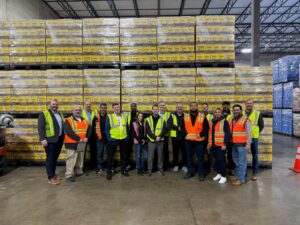
The newest expression of this belief is Odyssey’s AI Academy, an internal program built around a cohort of 150 employees from every corner of our business. It reflects a deliberately measured approach to AI: participants train on the latest AI tools, track how they use them, and bring forward ideas that can meaningfully improve how our business (and more importantly, our customers’ businesses) can run.
We think about the value from this approach in three stages. Personal productivity comes first; technology delivery is second. The third stage carries the most upside: reimagining how work flows when business and technology teams solve problems together.
For shippers, this is the point of the whole exercise: when the people who price freight, manage exceptions, and run customer programs find better ways to work, customers inherit the benefits.
Keeping the “I” in AI
One mantra from our AI Academy captures the intent behind all of this and informs where we plan to go: use AI, but don’t lose the “I.” The tools will keep getting more powerful. Our goal is to make sure they make our people, and our customers, more capable, more intelligent — not more removed from the decisions that matter. In a freight market that’s constantly moving, that’s a difference shippers will feel. It’s the integrated intelligence advantage from Odyssey.
Frequently asked questions
Which Odyssey customers have access to the new analytics dashboard?
The analytics dashboard is currently available to all customers.
What is network optimization in logistics, and how does Odyssey approach it?
Network optimization analyzes a shipper’s full logistics footprint — transport lanes, warehouse locations, carrier mix and total spend — to identify inefficiencies and cost reduction opportunities. Odyssey builds optimization models from proprietary data accumulated across its customer base, allowing shippers to surface savings and routing improvements that aren’t visible from inside their own operations.
How is Odyssey using AI across its logistics operations?
Odyssey is applying AI in several areas. SpotBot, one of Odyssey’s AI-powered pricing tools, automates freight rate analysis for brokerage customers. Natural language querying — allowing shippers to ask questions of their supply chain data in plain English — is in development for the managed services platform. Broader AI capabilities for network optimization and proactive supply chain decision-making are also being built out.