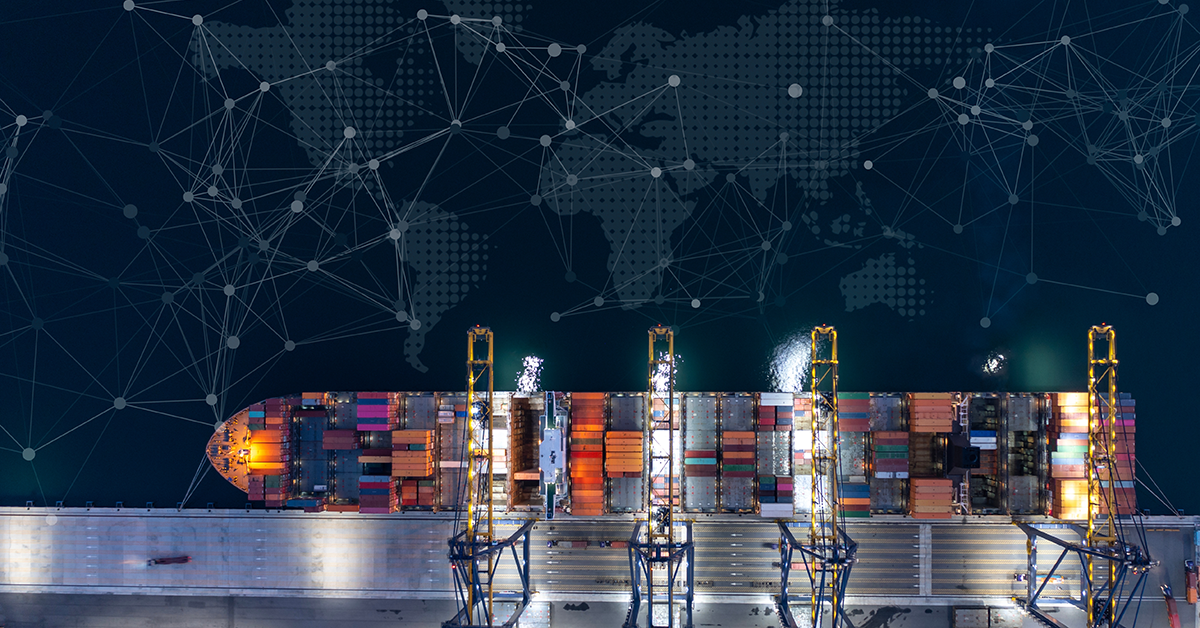
As supply chains become more connected, cybersecurity is becoming another critical dimension of supply chain reliability and resilience.
By Michael Irwin, Chief Information Security Officer, Odyssey Logistics
If you asked for an update on a critical shipment and the answer was, “We think the container is somewhere between the port and your facility,” you wouldn’t be too happy. You’d want to know whether it had cleared customs, left the terminal, transferred to rail, where it was headed next, and when it would arrive.
This level of precision depends on a constant exchange of data among carriers, logistics providers, warehouses, technology platforms, and other partners.
Each connection and data stream also expands the supply chain’s exposure to cyber risk. In many ways, cyber risk has grown more complex than the physical supply chain itself. Managing it is now as critical to reliability and resilience as managing any other supply chain risk. Yet visibility into cyber risk often remains limited to the equivalent of, “The container is somewhere between you and the port.”
Fortunately, this is a challenge (and solution) shippers know well: Confidence in the reliability and resilience of your supply chain comes from knowing what your operations depend on, monitoring conditions, and recognizing when something looks wrong. Applying that same thinking to cybersecurity can provide greater confidence in the digital infrastructure behind the physical supply chain.
Cyber risk follows every connection in the supply chain
Freight moves with incredible precision, even when parts of the wider technology ecosystem are seemingly held together with bubble gum and Scotch tape.
Modern supply chains depend on information moving quickly among carriers, logistics providers, warehouses, platforms, customers, and other partners. Those connections give teams the visibility and control needed to move freight with precision across a complex network.
Each connection also reaches farther than it first appears. Behind a carrier portal sits cloud infrastructure, while a warehouse system relies on third-party software and a platform exchanges data through integrations maintained elsewhere. Even when each organization protects its own environment, no one organization owns, monitors, or fully sees every dependency.
Several layers down, a critical connection sometimes involves a legacy application, a manual handoff, or an integration held together with the digital equivalent of bubble gum and Scotch tape. An issue deep within this chain still has the potential to interrupt operations across the network.
Modern logistics runs on sophisticated technology, but interconnected operations inherit risk from systems and organizations outside a shipper’s direct view. As shippers add lanes, carriers, facilities, and service providers, they gain greater flexibility while adding more digital dependencies to understand and protect.
Shippers already consider how each new partner affects cost, service, and reliability. Cybersecurity belongs in the same evaluation.
Unraveling Nth-party risk
In a connected supply chain, one company’s cyber risk extends to companies it may never have contracted with, or even know of.
Most organizations understand third-party cybersecurity risk. In logistics, the chain grows quickly. A shipper works with a logistics provider to move freight from A to B. The provider connects with carriers, those carriers use technology platforms, and the platforms rely on cloud infrastructure, data services, and other technology providers.
Before long, the shipment depends on systems managed by companies four or five steps removed from the original agreement.
Cybersecurity teams call this fourth-party or Nth-party risk. Put more simply, you depend on your vendors, your vendors’ vendors, and sometimes your vendors’ vendors’ vendors.
This layered structure is standard across modern supply chains. Specialized providers and connected platforms make complex operations possible. They also make it harder for any one organization to see every dependency, understand who has access, and trace how an incident would travel through the network.
Company size or familiarity offers limited insight into risk. Attackers look for trusted access, exposed connections, and services whose disruption would affect a larger target. When an incident starts several layers down, its effects still move through the organizations and operations connected to it. For small or mid-sized companies, it can be easy to think, “We’re too small. Why would someone hack us?” But attackers often see a smaller company as an easier path to a larger target.
Physical cargo security offers a useful comparison. A secure distribution center protects one point along the route, while freight still passes through terminals, vehicles, facilities, and handoffs outside its walls. Cybersecurity works the same way. Strong controls within one organization protect one part of a much larger system.
The ripple effect of cyber incidents in logistics
The breach might happen beyond your direct partners, but your freight and customers may still feel the impact.
Transportation management and ERP systems rely on information constantly moving among companies, allowing different companies to function as one connected supply chain. But this also allows disruption to move through those connections.
If a critical provider or platform becomes unavailable, freight can be delayed, inventory visibility can fall out of sync, and service commitments can be missed. Those disruptions can snowball into much larger, more tangible consequences: A production-critical component might not reach a plant when it’s needed. Temperature-controlled or other time-sensitive freight may have even less room to absorb a disruption.
Your customer doesn’t care that your own systems were never breached. They still expect their shipment on schedule.
That’s why cybersecurity can’t be viewed solely as an IT issue. For a shipper, it’s a critical form of operational risk.
The subtle signs of cybersecurity threats and cyber risk are easy to miss
Shippers need granular, real-time visibility into the data behind their operations because the earliest signs of cyber risk rarely look like alarms.
Cyber incidents often start with activity that looks completely legitimate:
- A partner employee logs in from an unusual place or at an unusual time, even though the account is legitimate.
- A trusted user suddenly downloads much more data than usual.
- A familiar device starts connecting to systems it hasn’t used before.
- A routine connection suddenly sends much more data than normal.
- A legitimate vendor account starts using an approved connection in an unusual way.
Those patterns can point to cybersecurity threats and raise data privacy concerns even before a breach is confirmed.
The key is understanding what normal activity looks like well enough to recognize when something changes. Connected systems also improve decision making by combining integrated data sources with real-time analytics, including predictive analytics and artificial intelligence tools that improve forecasting precision, forecast demand, identify supply chain risks, and help reduce waste and prevent stockouts. Centralized supply chain data also supports faster responses to inventory shortages and automated alerts when supply chain disruptions require coordination. That makes granular visibility incredibly important to seeing the subtle signs that something is slightly abnormal.
Cybersecurity is a critical dimension of supply chain resilience
Managing cyber risk requires the same discipline logistics leaders already use in supply chain risk management across complex supply chain ecosystems.
Cyber risk becomes complicated quickly, but logistics leaders already know how to manage risk across complex ecosystems. Shippers understand which partners and facilities their operations depend on, establish expectations, monitor performance, identify critical points of failure, and build contingency plans. When something deviates from the plan, timely information helps them respond before the disruption spreads.
At Odyssey, we apply the same discipline to cyber risk by asking three practical questions.
- What do we depend on? We map the systems supporting critical activities such as ordering, tendering, shipment visibility, and invoicing. We also examine the partners and service providers supporting those systems.
- Who can touch it? We identify which employees, partners, accounts, and systems have access to critical environments. We then confirm whether each point of access serves a legitimate business need and whether its permissions match the work involved.
- What happens if it goes down? This is where cybersecurity becomes an operations conversation. Which freight, facilities, customers or revenue depend on that digital connection or process? If a critical system or partner suddenly becomes unavailable, what stops working? Where do we have (or not have) alternatives?
Together, these questions give us the context to prioritize cyber risks instead of treating every technical issue as equally important. They also guide Odyssey’s broader Governance, Risk & Compliance program, including a formal risk register, risk-exception workflow, NIST Cybersecurity Framework-aligned assessments, and prioritized remediation roadmap.
Odyssey’s Assurance & Trust Portal gives customers additional visibility into the controls supporting our operations.
Four questions to ask your logistics provider about cyber risk
You don’t need to audit a provider’s security program to learn whether they understand and actively manage the risks behind your freight.
Cybersecurity can get technical very quickly, but evaluating a logistics provider doesn’t have to. Start with these four straightforward questions:
- Which of your systems does my freight depend on, and what breaks if one goes down?
Get the specifics: Which systems handle your orders, tendering, shipment visibility and invoices? What stops working if one becomes unavailable? What alternatives are available? If the answer is simply a list of certifications and security standards, ask again. - Who can access my data, and how often do you check that list?
Access piles up. People change jobs; integrations stay switched on long after the project that needed them ends; and vendor accounts outlive the contract. Ask how often someone reviews the list, and what would make them review it early. - How do you vet your own partners and subcontractors?
Your provider’s carriers, technology platforms, and software vendors’ exposure becomes your exposure, too. Ask what cybersecurity expectations they set for critical partners and how they would learn about an incident further down the chain. - If an incident touched my freight, when would I hear about it?
There’s a big difference between hearing about a problem early and hearing about it from your own customer. Ask how and when the provider would notify you about an incident affecting your operations. Then ask what actually happened the last time they ran a drill or dealt with a real event.
A good logistics provider doesn’t need a perfect answer to every hypothetical scenario. But they should understand what their operations depend on, have processes for managing those dependencies, and be able to explain them in terms that make sense to the people responsible for your freight.
Build the resilience before you need it
The strongest cybersecurity strategy reduces the chance you’ll need to rely on your incident response plan in the first place.
I like to compare cybersecurity controls to fire extinguishers in a warehouse. You absolutely want the fire extinguishers there. But putting more of them on the walls doesn’t inherently make the warehouse safer. They’re there for the moment when something has already gone wrong.
You make the warehouse safer by training people and putting safeguards in place that reduce the likelihood you’ll ever need the extinguisher.
Cybersecurity is no different. Responding to an incident is almost always harder and more expensive than doing the foundational work ahead of time: understanding dependencies, managing access, evaluating critical partners, recognizing unusual activity and addressing unnecessary exposures.
The goal is not to eliminate risk entirely, which is unrealistic in a dynamic ecosystem, but to understand and manage it in a way that protects operations, service, and profitability. The goal is to understand cyber risk well enough to manage it strategically.
Understanding what your operation depends on, where the most important exposures exist, what ‘abnormal’ looks like, and how to respond when a disruption does happen: those are the ingredients that shippers use to build reliability and resiliency across their supply chains. And they’re the same capabilities that give you confidence to manage cyber risk.
Consult with Odyssey’s supply chain experts about identifying critical dependencies, reducing cyber exposure and building greater resilience across your transportation network.
Frequently asked questions
What makes cybersecurity risk more complex in logistics?
Shipping depends on a broad network of carriers, platforms, providers, and other vendors, many of which rely on additional providers of their own. Each connection adds another system, relationship, or dependency that may sit outside a shipper’s direct view.
Why are smaller supply chain partners sometimes targeted by bad actors?
Attackers may look for a less-defended point in a connected network rather than targeting a larger, better-defended organization directly. A partner with fewer security resources, older infrastructure or less mature cybersecurity practices may provide an easier path toward breaching bigger companies and their operations.
How can a cyber incident affect freight movement?
Freight depends on connected systems for orders, shipment information, invoices and other operational data. When one of those systems or connections is interrupted, the effects may reach shipment movement, inventory visibility, service commitments and customer confidence.
Where should shippers start when assessing supply chain cybersecurity risk?
Start with visibility into the environment: which systems support critical business processes, which partners connect to them, who has access and what happens if a critical system or provider becomes unavailable. From there, prioritize the gaps most likely to create meaningful operational exposure.