In recent years, excess trucking capacity kept rates low and cost ruled every logistics decision. This window has closed, and metals shippers who optimized for price alone are now exposed.
For the last three years, the spot freight market rewarded shippers who treated carrier selection like day-trading — hunt the best rate available, move on. In a bull market with abundant capacity, this logic held. Shippers assumed carrier reliability as table stakes: cost was the only number that mattered.
Today, that market is gone. Capacity is contracting through carrier bankruptcies and tightening regulations. Operating costs — fuel, insurance and equipment — have steadily climbed, and rate strategies built for a soft market are backfiring.
Reliability has become the primary decision driver, and shippers who built their networks around low rates are feeling the exposure. Odyssey Logistics has spent years building a metals network that performs in this environment with long-term carrier relationships, strategically placed assets, multimodal infrastructure, and the technology and service culture to keep customers informed.
Why carrier reliability matters more in metals than most freight categories
Metals freight demands specialized equipment, trained operators, and continuity. The carrier handling a steel coil today needs to know facility layouts and handling requirements, and this knowledge takes time to build and doesn’t transfer to a spot-market replacement.
The cost of a missed pickup or a mishandled load lands directly on the shipper’s own customer. At this point, the savings from a lower-rate carrier can evaporate in a single failed delivery. In markets like this, carrier reliability is paramount.
Relationships overload boards
In our approach, Odyssey builds its carrier relationships around consistent volume and mutual accountability. When problems come up, Odyssey takes a hands-on approach to remediation whether an owned truck or a partner carrier is involved. This standard earns carrier loyalty that makes a difference when capacity is contested.
On the asset side, Odyssey’s flatbed network is positioned for short-mile, high-velocity, heavy-weight moves — the profile that defines most metals freight in the Midwest. Locations in Cleveland, Chicago, Northwest Indiana, St. Louis, Arlington (Texas), and Denver put Odyssey assets close to the facilities they serve. For longer-haul movements, deeply embedded partner carriers extend this reliability without extending the asset base.
Intermodal's advantage — and why integrated networks are built for it
For two years, the math didn’t always favor intermodal. Trucking was cheap enough that shippers could get faster transit at comparable cost. As OTR rates rise, intermodal is reasserting its cost advantage on longer lanes.
What we’ve seen is intermodal works for metals when the first and last mile are solved. Odyssey’s flatbed assets handle pickup from origin and delivery to the consolidation facility on the front end, and final delivery to the end user on the back. Where assets aren’t positioned, partner carriers fill the gap — operating in markets like Los Angeles practically as an extension of Odyssey’s own fleet. This secures consistent coverage and capacity for shippers even when the broader market tightens.
When supply chains break: how a distributed logistics network responds
A supply chain built around the lowest available rate has the same problem as a Jenga tower — it holds until the moment it doesn’t.
Earlier this year, a facility disruption at a major aluminum producer forced rapid restructuring of its supply chain. Import volumes shifted from domestic supply to overseas sourcing, and freight that had been moving through Odyssey’s Midwest facilities began moving through West Coast facilities on a different mode.
Odyssey’s flexible network allowed it to rebalance the producer’s supply chain quickly. Facilities in different regions absorbed different loads, and different modes filled different gaps, ultimately upholding service continuity.
- Where are your single points of failure, and how vulnerable are they to disruption?
- If your primary carrier lost capacity tomorrow, how quickly could you replace it?
- Does your logistics provider have warehouse and carrier coverage that maps to your current suppliers and customers?
- Can your network shift modes without restarting from scratch?
It’s easier to answer these questions before conditions force the issue. In 2026, reliability should be well-established before disruption arrives.
Visibility and the service standard technology can't replace
Odyssey is enhancing its Warehouse Management System (WMS) across its transport and warehouse operations. The WMS will give customers real-time inventory access, shipment management, and performance analytics through a single login, with EDI handling data flows automatically. This way, shippers always know where their inventory stands, allowing them to make smoother planning decisions.
Technology, however, should support accountable service and not replace it. When shippers call Odyssey dispatch or the warehouse, a person picks up. Reports go out on whatever cadence the customer needs — daily, weekly, monthly — to ensure shippers keep a close eye on their freight. A pattern of regular, accountable communication from Odyssey allows shippers to feel confident about their supply chain.
As automation absorbs more of the transactional layer in logistics, retaining the human element has become an important differentiator. While AI delivers efficiencies across our network that we pass on to customers, Odyssey has made a deliberate choice to preserve human service.
How to build a metals logistics network for a reliability-first market
We anticipate carrier capacity will stay tight, tariff-driven sourcing shifts will keep creating new freight patterns and disruptions will keep arriving on short notice.
A logistics strategy built around long-term carrier relationships, a distributed warehouse footprint and genuine multi-modal capability absorb all these changes.
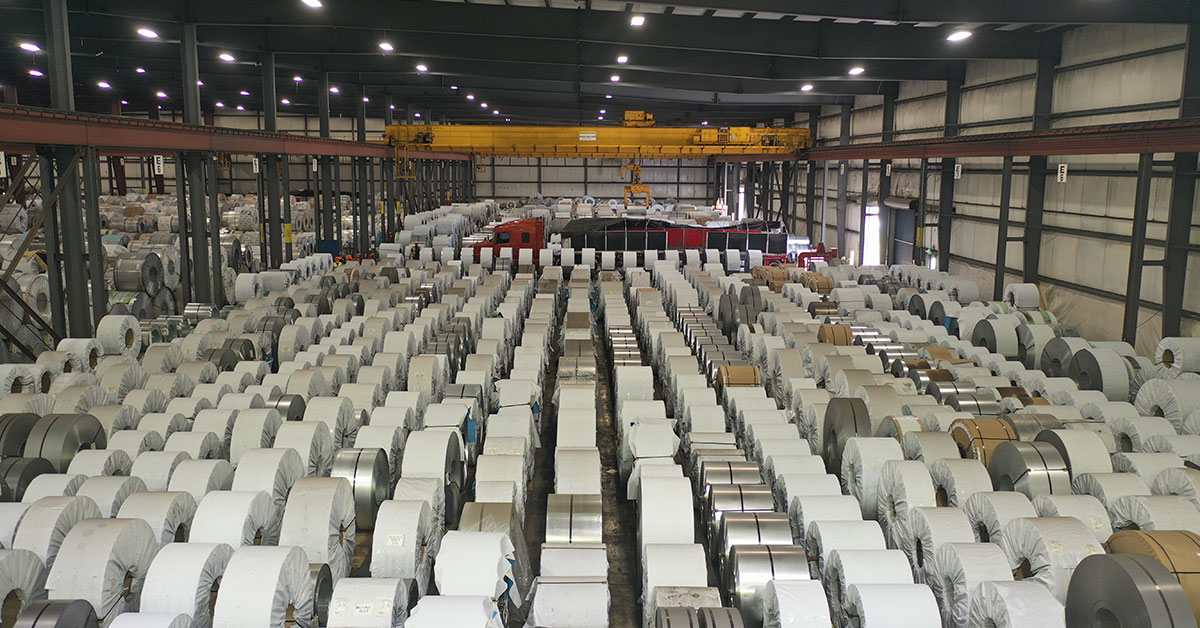
In 2026, Odyssey opened 200,000 square feet of metals warehousing in Cleveland and is evaluating 400,000 more in additional locations — capacity being built in direct response to what shippers are asking for right now.
If you’re rethinking how your metals supply chain should work in 2026 and beyond, we can help you pressure-test lanes, modes, and facility coverage.